
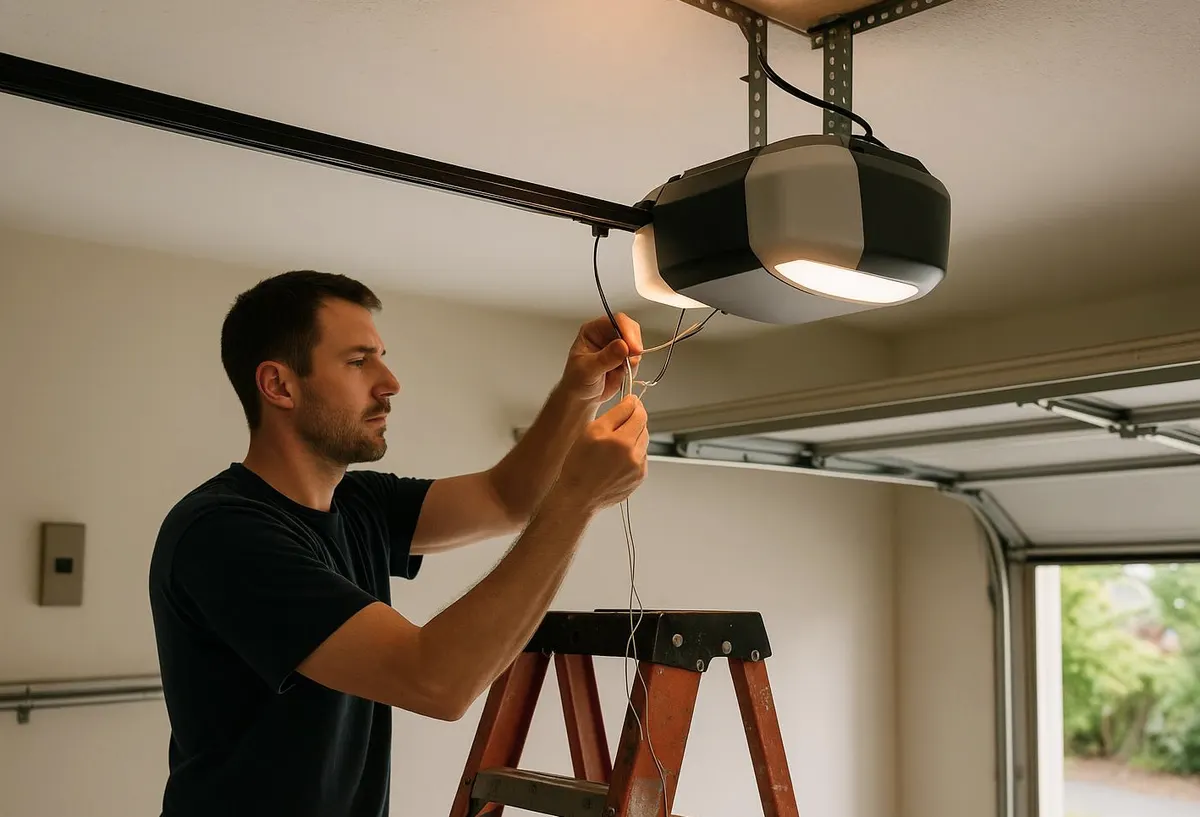
What a Technician Hears on This Call
It usually starts the same way: the power went out during a rainstorm or a wildfire-season shutoff, one car was stuck in the garage, and now one spouse is convinced they need a battery backup opener immediately while the other thinks it's an unnecessary upsell. By the time we get the call, both sides have already looked it up online and found conflicting answers. Here's the version that actually settles it.
How Battery Backup Actually Works
A battery backup opener has a sealed rechargeable battery built into or attached to the opener unit itself. Under normal conditions, the battery just sits there trickle-charging off your home's power. When the power cuts out, the battery automatically takes over and runs the opener motor, letting you use your remote or wall button as if nothing happened.
A few things to know about what it does and doesn't do:
- It powers the opener motor and its safety features (photo-eye sensors, auto-reverse) — it does not run garage lights on a separate circuit or anything else in the house.
- Most units are rated for a limited number of open/close cycles per charge, often somewhere around 10 to 20 cycles, not unlimited use for days.
- The safety sensors still function on battery power, so the door still stops and reverses if something is in the way — it's not a stripped-down emergency mode.
When You Actually Need One
This is the part that ends most arguments. Battery backup isn't required for a garage door to function — every opener has a manual release cord that disconnects the trolley so you can lift the door by hand during an outage. The real question is whether manual lifting is realistic for your household.
A battery backup earns its keep when:
- Your garage is the main or only easy entry point to the house, and climbing out of a car to manually crank open a heavy door isn't practical for everyone in the family.
- You're in an area that sees planned power shutoffs during dry, high-wind wildfire-season stretches, or you regularly lose power during winter rain events.
- You have a heavier door — a double-wide steel or custom carriage-style door — that's genuinely hard to lift by hand even after disconnecting the opener.
- Someone in the household has mobility limitations that make manual operation difficult or unsafe.
If none of that applies and you just park on the street during outages anyway, a backup battery is more convenience than necessity. It's also worth noting that many openers sold today simply come with battery backup built in standard, so for new installs it may not be an optional add-on at all — worth confirming with whoever is doing the install.
The Real Trade-Offs
Battery backup units cost more upfront than a basic opener, typically adding a few hundred dollars to the price depending on the model. The battery itself isn't permanent — most need replacing every few years as they lose capacity, especially in garages that run hot in summer, which shortens battery life faster than a cooler space would. And it's not a substitute for other safety upgrades like earthquake bracing on the track or surge protection for the opener's circuit board — it solves one specific problem: operating the door when the power is out.
When to Call Rancho Santa Margarita Garage Door Specialists
If you're not sure whether your current opener supports a battery backup add-on, or your existing backup battery won't hold a charge anymore, that's a straightforward diagnosis for us. We handle both Opener Repair & Installation and ongoing Garage Door Maintenance, so we can check your opener's condition, test the battery's actual runtime, and tell you honestly whether an upgrade makes sense for your household or whether your manual release is sufficient as-is.
If a storm or power shutoff has already left you stuck, our Emergency Garage Door Service covers that too. Give Rancho Santa Margarita Garage Door Specialists a call and we'll sort out what your household actually needs — no upselling, just a straight answer.